
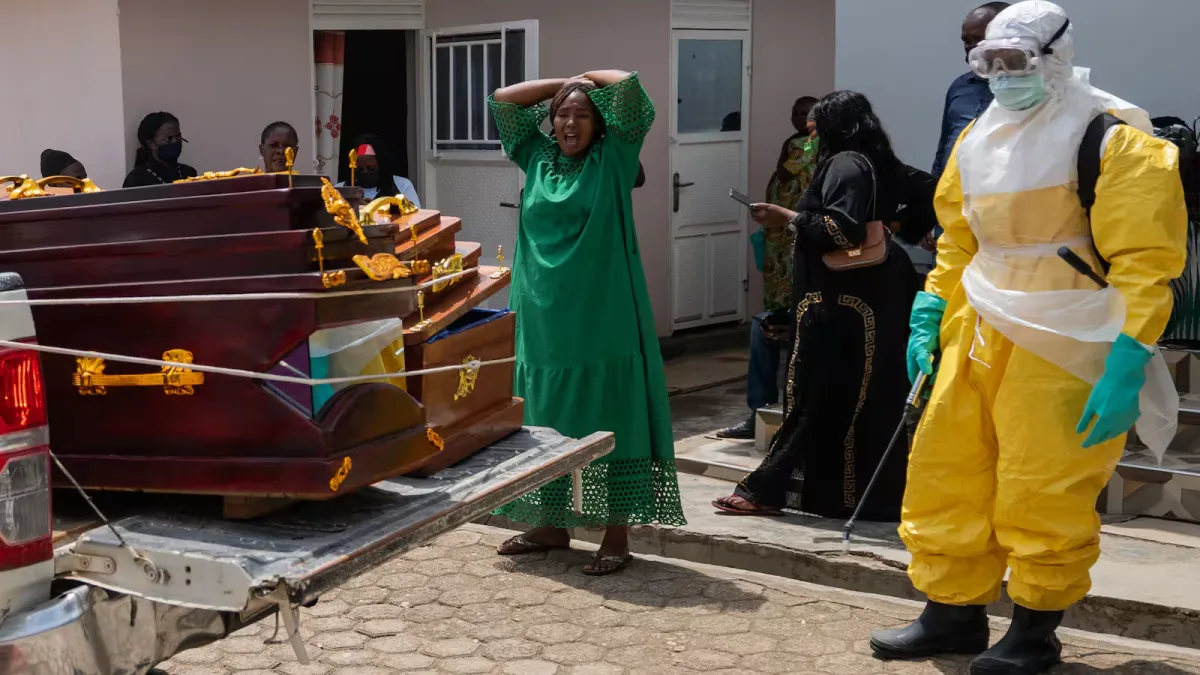
The Democratic Republic of the Congo is facing a worsening Ebola crisis, where the Bundibugyo strain of the virus is spreading rapidly in eastern regions already ravaged by armed conflict, mass displacement, and severe food insecurity. The World Health Organization (WHO) has issued an urgent warning, describing the situation as a “catastrophic collision of disease and conflict,” where containment efforts are being overwhelmed by insecurity and humanitarian collapse.
Since the outbreak began, health authorities have recorded nearly 1,000 suspected Ebola cases across 11 health zones, with over 220 suspected deaths, though only one death has been laboratory confirmed. The virus has spread beyond Ituri province into North Kivu, including Butembo and Goma, as well as South Kivu, raising concerns about cross border transmission. Uganda has already reported seven confirmed cases linked to the outbreak, including two healthcare workers and one death.
The Bundibugyo strain, first identified in Uganda in 2007, poses a particular challenge because it lacks an approved vaccine or treatment. Health officials warn that the virus is spreading through family clusters, healthcare facilities, and unsafe funeral practices, compounded by caregiving and community gatherings. Insecurity has further hindered response efforts, with attacks on health facilities and restrictions imposed by armed groups disrupting contact tracing and isolation measures.
Armed violence in the region has long constrained humanitarian access, as documented by the UN peacekeeping mission MONUSCO in a December 2025 report. The conflict, involving groups like the Allied Democratic Forces (ADF), CODECO militias, and the Rwanda backed M23, has led to widespread civilian displacement, attacks on villages, and the destruction of essential services. Active fighting has also disrupted food distribution, leaving nearly 10 million people in Ituri, North Kivu, South Kivu, and Tanganyika facing acute hunger between January and June 2026. Nationwide, an estimated 26.5 million Congolese are experiencing severe food insecurity.
WHO Director General Tedros Adhanom Ghebreyesus emphasized the compounding risks, stating that “hunger and disease are old companions.” Malnutrition weakens immunity, making populations far more vulnerable to infections. Meanwhile, poor infrastructure and damaged roads further limit the movement of aid and medical supplies, leaving many health facilities nonfunctional or operating under severe constraints.
Children are among the most affected, facing not only the direct threat of Ebola but also the loss of parents and caregivers, disrupted education, and stigma within communities. The UN Children’s Fund (UNICEF) has warned that the outbreak’s impact on children extends beyond illness, as displacement and fear isolate vulnerable families.
With no approved vaccine or treatment available, the outbreak’s trajectory remains uncertain. The WHO has urged immediate international support to strengthen response efforts, but the ongoing conflict and humanitarian crisis continue to pose insurmountable challenges to containment.




DISCUSSION (0)