
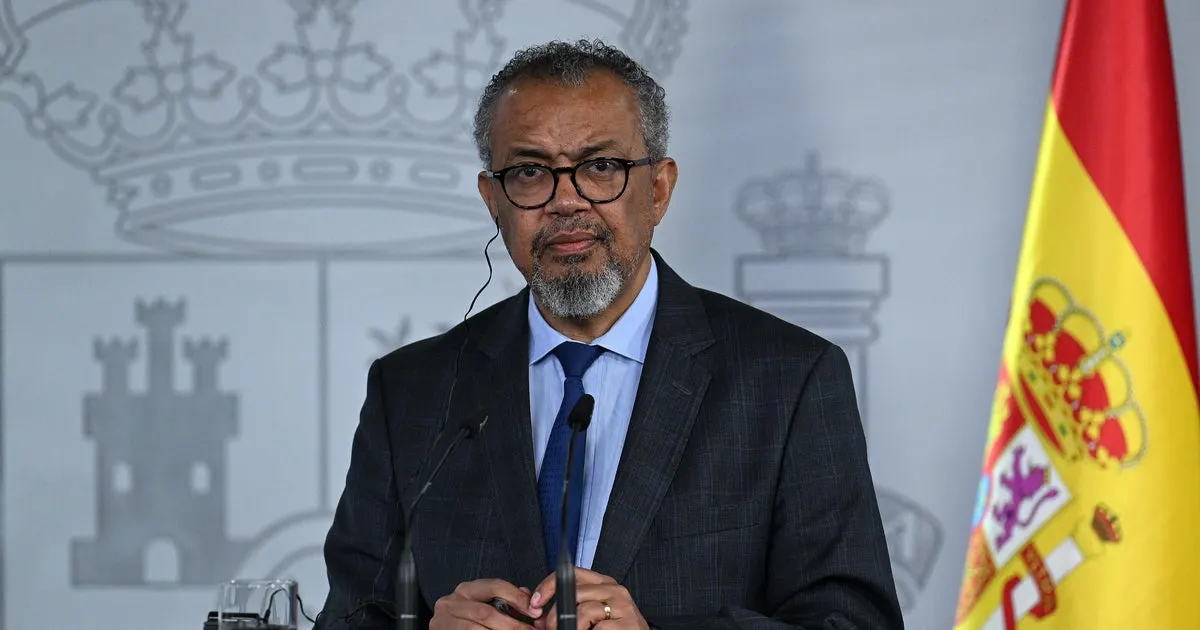
The World Health Organization’s Director General, Tedros Adhanom Ghebreyesus, arrived in the Democratic Republic of Congo’s eastern region on Thursday to reinforce support for public health efforts amid a worsening Ebola outbreak. Addressing the Congolese people directly, Tedros emphasized solidarity and commitment, stating, “Together, we will overcome this outbreak.” His visit comes as the Bundibugyo strain of Ebola, responsible for the current crisis, has already claimed at least 220 suspected deaths and infected nearly 900 people, according to WHO data.
The outbreak has extended beyond Congo’s borders, with seven suspected cases reported in neighboring Uganda. Health authorities warn the true scale of the outbreak may be larger, as the virus has likely circulated undetected for an extended period. Unlike previous outbreaks, there is currently no approved vaccine or treatment for this strain, complicating containment efforts.
Uganda’s government responded to the crisis by closing its border with Congo “with immediate effect,” a move WHO has criticized as counterproductive. Tedros and the United Nations have repeatedly warned that travel restrictions often exacerbate outbreaks by disrupting coordinated responses. Instead, the WHO has urged regional cooperation, emphasizing that containment requires open communication and shared resources.
The outbreak’s epicenter lies in eastern Congo, a volatile region plagued by decades of conflict and armed group activity. Tedros directly appealed to warring factions, calling for a ceasefire to facilitate humanitarian access and medical intervention. “Conflict and displacement make everything harder,” he stated. “I am making a direct appeal to all warring parties in this region: please, declare a ceasefire.”
Regional health leaders have expressed cautious optimism, with Jean Kaseya, Director of the Africa Centres for Disease Control and Prevention (Africa CDC), announcing that a vaccine for the Bundibugyo strain could be developed by the end of 2026. “Our leaders are ready to invest,” Kaseya said, “at both the technical and strategic levels, to ensure this vaccine becomes a reality.” The Africa CDC has pledged accelerated research and funding to address the crisis, though the timeline remains dependent on scientific progress and logistical challenges.
This is the 17th recorded Ebola outbreak in Congo, a nation of over 100 million people. The persistent threat of violence, displacement, and limited healthcare infrastructure in the region continues to hinder response efforts. As Tedros underscored, the path forward demands not only medical solutions but also political stability and international collaboration to curb the spread of this deadly virus.




DISCUSSION (0)