
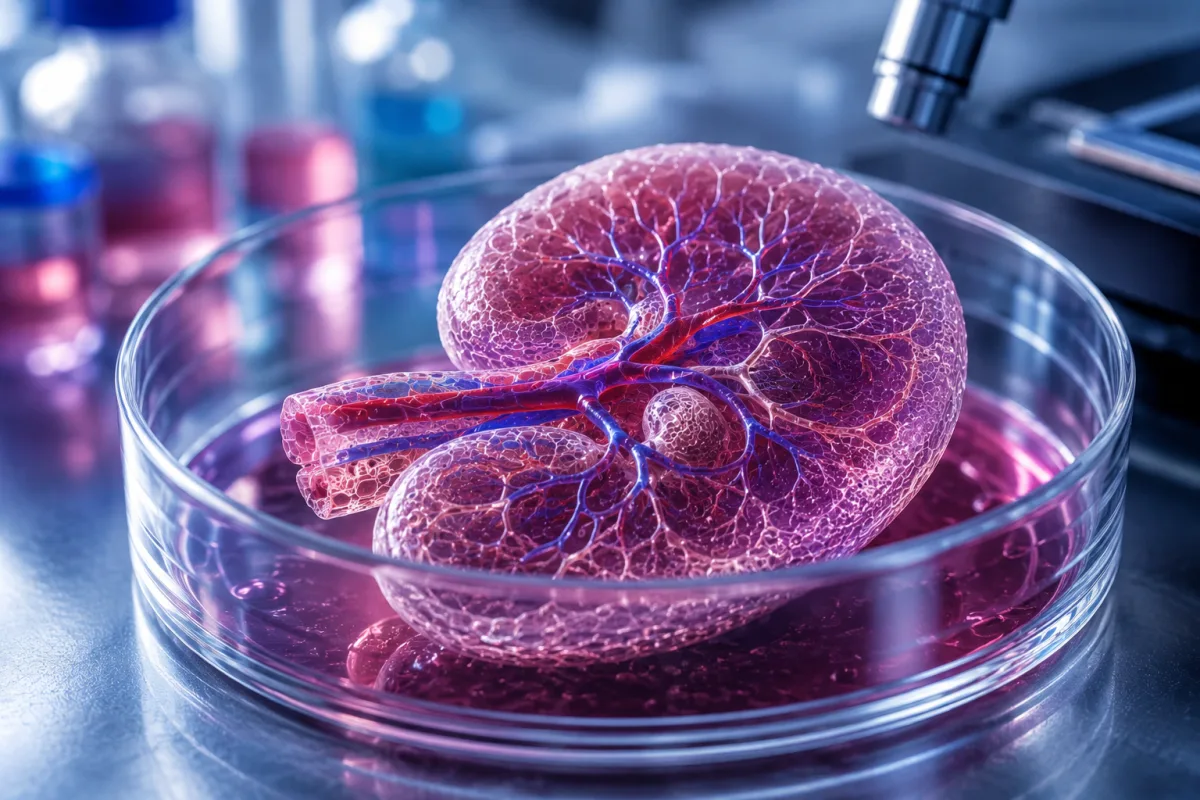
A groundbreaking study by researchers at the Keck School of Medicine of the University of Southern California (USC) has introduced a new method to improve the accuracy and reproducibility of lab grown kidney organoids, a critical advancement for regenerative medicine and disease research.
The team, led by Dr. Nils Lindström and Dr. Leonardo Morsut, identified an unrecognized developmental axis in the human kidney that guides the formation of nephrons, the kidney’s filtering units. By engineering synthetic ‘organizer’ cells, they replicated key developmental signals within the organoids, creating a more controlled and biologically accurate environment.
Unlike traditional organoid models, which rely on broad chemical signals, the synthetic organizer cells secrete specific Wnt proteins locally, mimicking natural developmental processes. This targeted approach not only enhances the structural precision of the organoids but also enables researchers to influence cell identity and shape formation more effectively.
‘With our approach, we are not overriding self organization but working with it,’ explained Dr. Morsut, emphasizing the method’s potential to refine preclinical disease modeling and therapeutic testing. The findings, published in Science, demonstrate that localized Wnt signaling not only directs cell differentiation but also induces physical elongation of nephron tubules toward the signal source, a behavior more closely aligned with natural kidney development.
‘A single, localized signal achieved two critical functions: it altered cell identity and physically oriented the tubules toward the source,’ said Dr. Lindström. ‘This level of control is impossible with uniform chemical signaling.’
The innovation holds promise for advancing organoid based research, offering a more reliable platform for studying kidney diseases and evaluating potential treatments. As Dr. Lindström noted, ‘Achieving reproducibility in organoid models is essential for developing robust preclinical tools that can ultimately benefit patients.’
The research builds on a decade of progress in organoid science, where self organization has been the primary driver of tissue formation. By refining this process with synthetic organizers, the USC team has taken a significant step toward generating transplantable kidney tissue, a long term goal in regenerative medicine.




DISCUSSION (0)