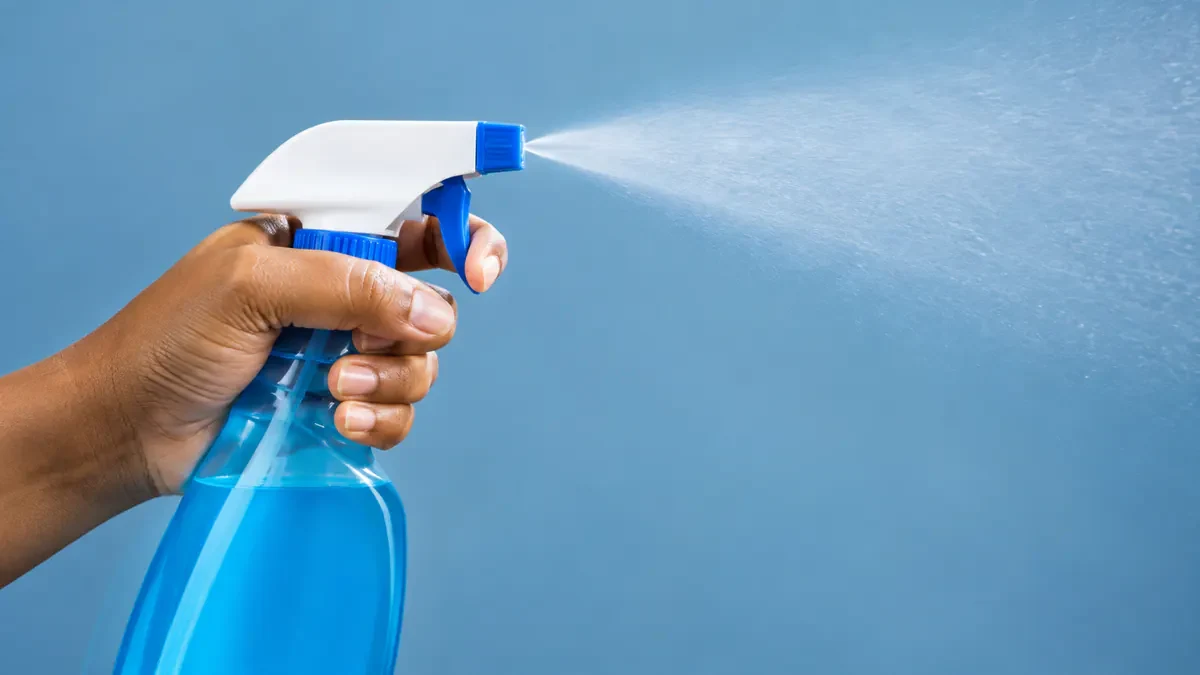
The familiar scent of a freshly cleaned home might come with an invisible health risk: billions or trillions of ultrafine nanoparticles that can penetrate deep into the lungs.
Researchers at Purdue University have discovered that fragranced cleaning products, whether conventional or botanical, can rapidly react with indoor ozone to generate nanoparticles within minutes. These particles, often invisible to the naked eye, may produce an inhaled dose comparable to or even exceeding that of standing near heavy traffic.
The study, presented at the American Chemical Society’s fall meeting, highlights a paradox in indoor air quality: while cleaning removes harmful viruses and bacteria from surfaces, it can simultaneously generate secondary air pollution that poses respiratory risks.
“Cleaning removes viruses and bacteria from surfaces, but it can also generate invisible air pollution,” said Brandon Boor, assistant professor of civil and construction engineering at Purdue. “There’s no visible dust or smoke in the air, but these particles are forming.”
The research, conducted in a model home on Purdue’s campus, found that routine cleaning tasks, such as mopping, spraying countertops, or wiping surfaces, can produce billions or trillions of ultrafine particles (1, 30 nanometers in diameter). These particles are small enough to bypass standard air quality monitors and penetrate deep into the respiratory system, potentially causing irritation and inflammation.
Boor and his team observed that the process occurs rapidly, within minutes of cleaning, and can temporarily push ultrafine particle levels above those found outdoors. The particles form when terpene compounds (such as limonene from lemon, pinene from pine, and linalool from lavender) in scented cleaners react with ozone, a common indoor pollutant.
“By the time you finish cleaning up an indoor space, you’ve already formed a lot of nanoparticles and inhaled them,” Boor explained. The study also found that using ozone generating devices like far UV lamps simultaneously with scented cleaners intensifies nanoparticle formation, raising additional health concerns.
The researchers recommend reducing exposure by choosing unscented or low fragrance products, improving ventilation with exhaust fans or open windows, and avoiding the use of ozone generating devices while cleaning. Boor emphasized that the goal is to help consumers make informed choices without discouraging necessary cleaning practices.
The findings, published under the title Indoor atmospheric nanoparticle formation from scented cleaning products, were supported by the National Science Foundation and the Alfred P. Sloan Foundation. The study underscores the need for better ventilation, air cleaning strategies, and product formulations to mitigate indoor air pollution risks.








DISCUSSION (0)