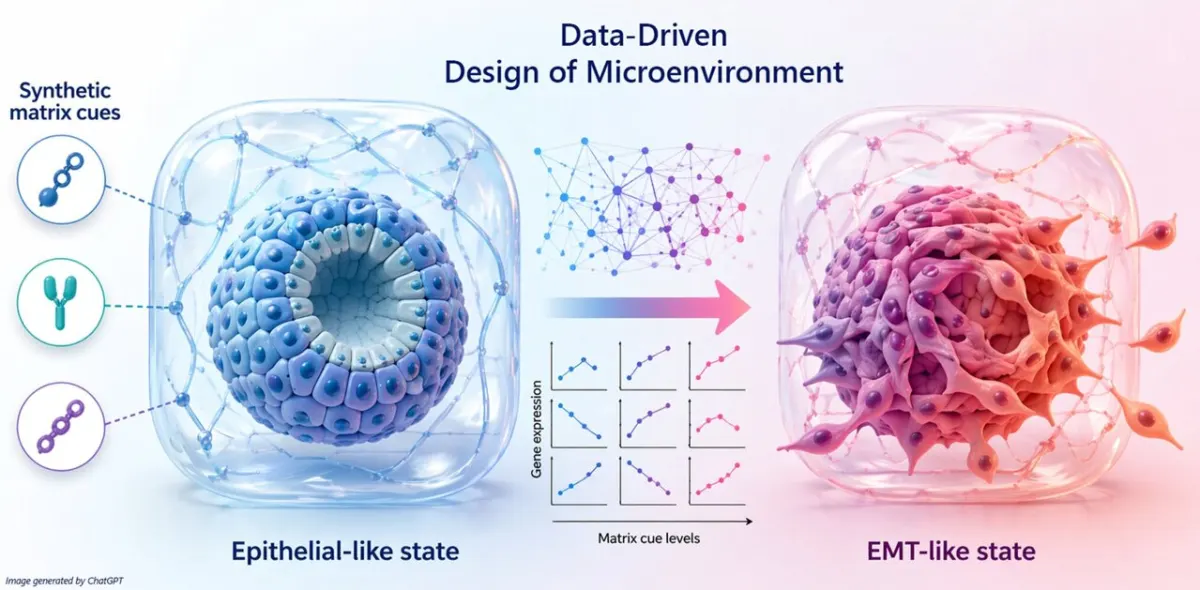
A groundbreaking study from the Leibniz Institute of Polymer Research Dresden has demonstrated how engineered biomaterials can systematically guide pancreatic cancer organoids into distinct cell states, offering new avenues for understanding tumor biology and therapeutic development.
The research, published in Advanced Materials, addresses a long standing challenge in oncology: the ability to control how cancer cells transition between different functional states. Patient derived organoids, miniature, genetically faithful models of tumors, have emerged as powerful tools for studying cancer, as they retain key features of the original tissue, including its architecture and cellular diversity.
Unlike genetic manipulation, which is commonly used to study these transitions, the Dresden team focused on modifying the organoids’ microenvironment. By designing synthetic hydrogels composed of star shaped polyethylene glycol (PEG) functionalized with bioactive peptides, they created a platform capable of influencing gene expression and cellular behavior in response to specific biochemical cues.
The approach, led by Dr. Ali Nadernezhad, leveraged data driven design to correlate hydrogel composition with organoid gene expression profiles. Through systematic experimentation, the researchers identified formulations that could direct pancreatic cancer organoids toward an epithelial to mesenchymal transition (EMT)-like state, a process strongly linked to cancer progression, metastasis, and resistance to treatment.
‘This work represents a paradigm shift in how we study cancer,’ said Professor Daniel E. Stange of Universitätsklinikum Carl Gustav Carus Dresden, who collaborated on the study. ‘By engineering the physical and chemical environment, we can now observe and influence cellular behaviors in ways that were previously impossible.’
The implications extend beyond pancreatic cancer. The methodology could inform broader cancer research, regenerative medicine, and the development of biomaterials for precision oncology. As the team continues to refine their platform, the potential to uncover previously inaccessible cellular states, and to test targeted interventions, grows.
The study, titled ‘Bottom Up Programming of Cell States in Cancer Organoids with Defined Synthetic Adhesion Cues,’ was published on May 21, 2026, in Nature’s Advanced Materials. DOI: 10.1002/adma.202517390.






DISCUSSION (0)