
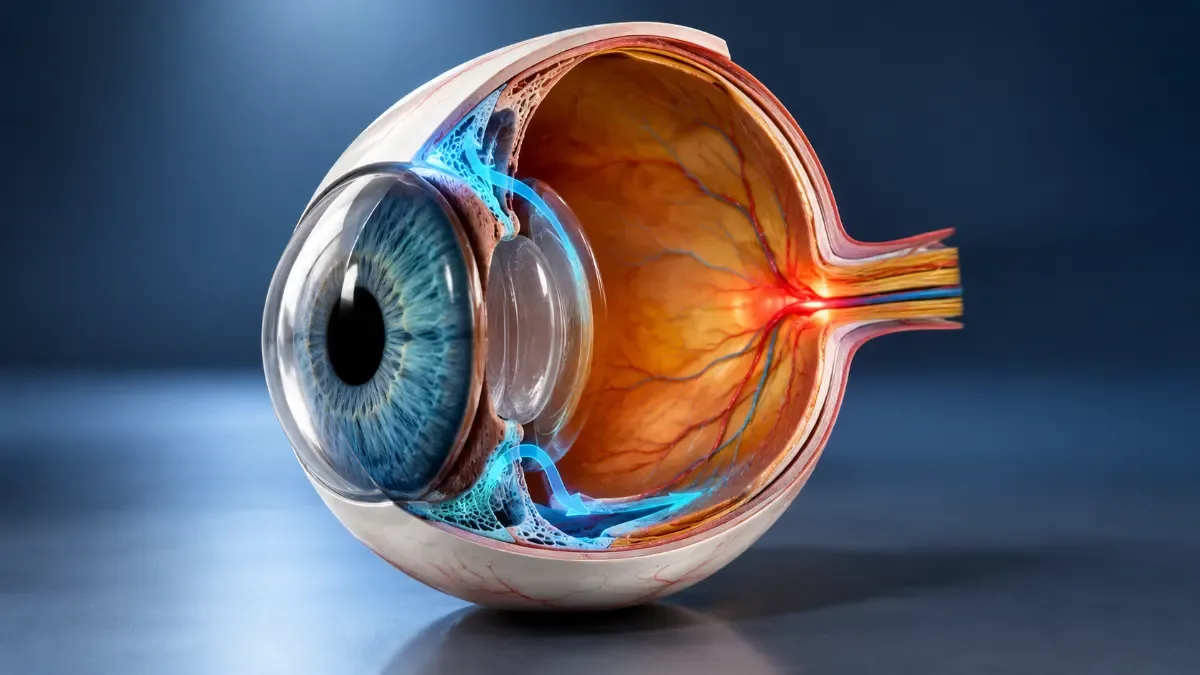
The eye contains a previously unknown waste removal system that could fundamentally change how scientists understand and treat major causes of blindness, according to new research from the University of British Columbia and University of Toronto.
Scientists have identified a hidden drainage pathway called the posterior ocular lymphatic outflow (POLO) pathway that carries fluid and metabolic waste from the back of the eye into the body's lymphatic system. The discovery, demonstrated in mice, challenges long standing assumptions about ocular physiology and offers potential new targets for treating glaucoma, age related macular degeneration, and other vision threatening conditions.
The retina, located at the back of the eye, is one of the body's most metabolically active tissues, continuously generating waste products that must be cleared to maintain proper function. Until now, researchers lacked a clear explanation for how this sensitive region removes unwanted substances. The newly discovered POLO pathway provides that missing link, showing that fluid and waste can escape through lymphatic vessels in the choroid - a thin, blood vessel rich layer beneath the retina.
'The retina is constantly generating byproducts that need to be cleared,' explained Dr. Neeru Gupta, professor and head of UBC's department of ophthalmology and visual sciences. 'This discovery helps explain how the eye flushes this waste and promises to transform how we think about and treat a range of eye conditions.'
The research team used advanced imaging techniques including MRI and near infrared fluorescence imaging to trace the movement of fluorescent molecules injected at the back of the eye. Within minutes, they observed the molecules traveling through newly identified lymphatic vessels in the choroid and reaching nearby lymph nodes, confirming the existence of this previously unrecognized drainage route.
'Because lymphatic vessels in the choroid were thought not to exist, we had to use multiple techniques to demonstrate both their presence and function,' said Dr. Yeni Yücel, professor and director of ophthalmic pathology at the University of Toronto. 'We were surprised to see such a direct route for fluid to leave the eye and connect with the lymphatic system.'
The findings, published in Translational Vision Science & Technology, suggest that fluid accumulation in the back of the eye - a key factor in conditions like glaucoma and macular degeneration - may be more directly connected to the body's lymphatic system than previously understood. While the research was conducted in mice, the implications for human eye health are significant.
'This is a foundational discovery that shows the eye is not as closed a system as we previously thought,' Dr. Gupta stated. 'It gives us a new map, a new mechanism and a new set of questions to explore.'
The research was supported by multiple Canadian health research organizations including the Canadian Institutes of Health Research and the Glaucoma Research Society of Canada. While the discovery opens new avenues for research, the team emphasizes that further studies are needed to understand how this pathway functions in humans and whether it can be safely targeted for therapeutic purposes.
Age related macular degeneration alone affects approximately 2.5 million Canadians, making the potential implications of this research particularly relevant. If scientists can determine how to enhance or exploit this natural cleanup system, it could provide new approaches for preventing vision loss and protecting retinal health.
The discovery follows earlier work by the same research team that identified a lymphatic drainage route in the front of the eye in 2009. Together, these findings suggest that the eye's waste removal system is more complex and interconnected than previously believed, offering new possibilities for understanding and treating blinding diseases.




DISCUSSION (0)